

Compost can save the world! It sucks carbon dioxide out of the air and not only that, a half-inch layer of this black gold can still increase yields six years after its application. I had been composting in our community bins for nearly 10 years—and for several years before that at my house—but decided to start a rogue pile in my yard several months ago. I can’t grow much out there in the shade but food scraps will certainly rot. In fact, I can’t possibly prevent the natural process of rot.
When I composted at my house years ago, like many people, I believed I needed to buy a special bin. For my new compost pile, I wanted to create a simple, inexpensive system. I could have made a cylindrical bin out of chicken wire or built an upcycled bin from wooden pallets (both great options). But instead I bought nothing. I built nothing. I took what I had collected in the kitchen and threw it on the ground.

I throw everything on my pile:
- Fruit peels, scraps and all pits. Even avocado pits break down quickly!
- Vegetable peels and scraps. I make vegetable broth out of most little bits of vegetables, after which they go on the pile.
- Corn cobs. I couldn’t believe how quickly these dry out. After a couple of weeks, I can easily break them up into 1- or 2-inch pieces to speed up their decomposition.
- Butter wrappers. I have mentioned many times on my blog that I refuse to give up butter. I recycle the paper box and throw the wrappers on the ground. “I’M AN ADULT!” (Straus butter wrappers are compostable. You may have to do a little investigating to find out if your brand’s are also.)
- Bones. Most people will tell you never to add bones to compost. We don’t eat much meat, but when we do, I make bone broth and then add those bones to the pile. Within weeks, they petrify and I can easily crush them into powder with my hand. I couldn’t even find any in the first pile today. They had completely broken down. Amazing.

I have read that meat and bones attract animals but I attract animals regardless. Until this morning, I had no bones on my pile (the last ones broke down weeks ago) and yet an opossum has been dining at chez Bonneau nightly. My kids named him Richard Nixon. Through my bedroom window, I hear Richard Nixon out there in the middle of the night rustling through the leaves, eating his dinner. You may not want an opossum in your yard but I think he (or she) is cute (I saw him this morning). We tried to capture footage of him on a motion-detector, night-vision camera my neighbor set up in my yard, but Richard Nixon is a sneaky one. We captured only me working out there.
Even with a couple of my neighbors adding their food scraps to my pile, it’s small enough that I don’t feel the need to build any sort of bin to contain it. The critters visit the pile from the earth beneath and set to work chowing down and converting the scraps to rich, loamy soil that I can use in my vegetable bed. And I have tons of critters! Right now, I don’t have as many worms as I would like. I need to do a better job of keeping my pile moist. The summer heat makes this more difficult. But as I said, you cannot stop compost from breaking down—it actually ferments, as we all will one day—and you can’t really mess it up if you follow a few simple steps. This is what I do:
1. Throw kitchen scraps on the pile. These are called green materials.
2. Throw a handful of brown materials on top, such as leaves, shredded corn stalks or hay. The giant acacia tree in my yard, under which my compost piles sit, rains down leaves constantly. I use those. By creating air pockets, brown materials prevent your pile from becoming a soggy, smelly mess.
3. Add moisture to the pile. Compost will dry out in the summer, so ideally, situate your pile in a shady spot.
4. Turn the pile every few days to inject it with air, which helps speed up decomposition. My neighbor says I don’t need to turn such small piles. Like sourdough bread making, you’ll find various recipes for compost. I’m just describing what I do. You may want to do it a little differently.

5. Once the first pile becomes large and starts to break down and cook, start a second pile. And it really does cook. My second active pile felt very hot today when I turned it! How thrilling! The heat means it’s working. The piles are a little difficult to make out in the picture below. The finished pile sits behind the cooking pile.

6. Remove the compost from the first pile, pull out any noticeably large pieces that haven’t broken down, like the corn husks I should have shredded below, and throw them on the second pile. Work the compost from the finished pile into your soil where desired.

7. After using up the first pile, let the second pile cook and throw scraps where the first pile had been. By starting a second pile, I have one cooking and one ready (or nearly ready) to use.
Of course you can get much more scientific about your compost than my steps here do. This is another good resource.
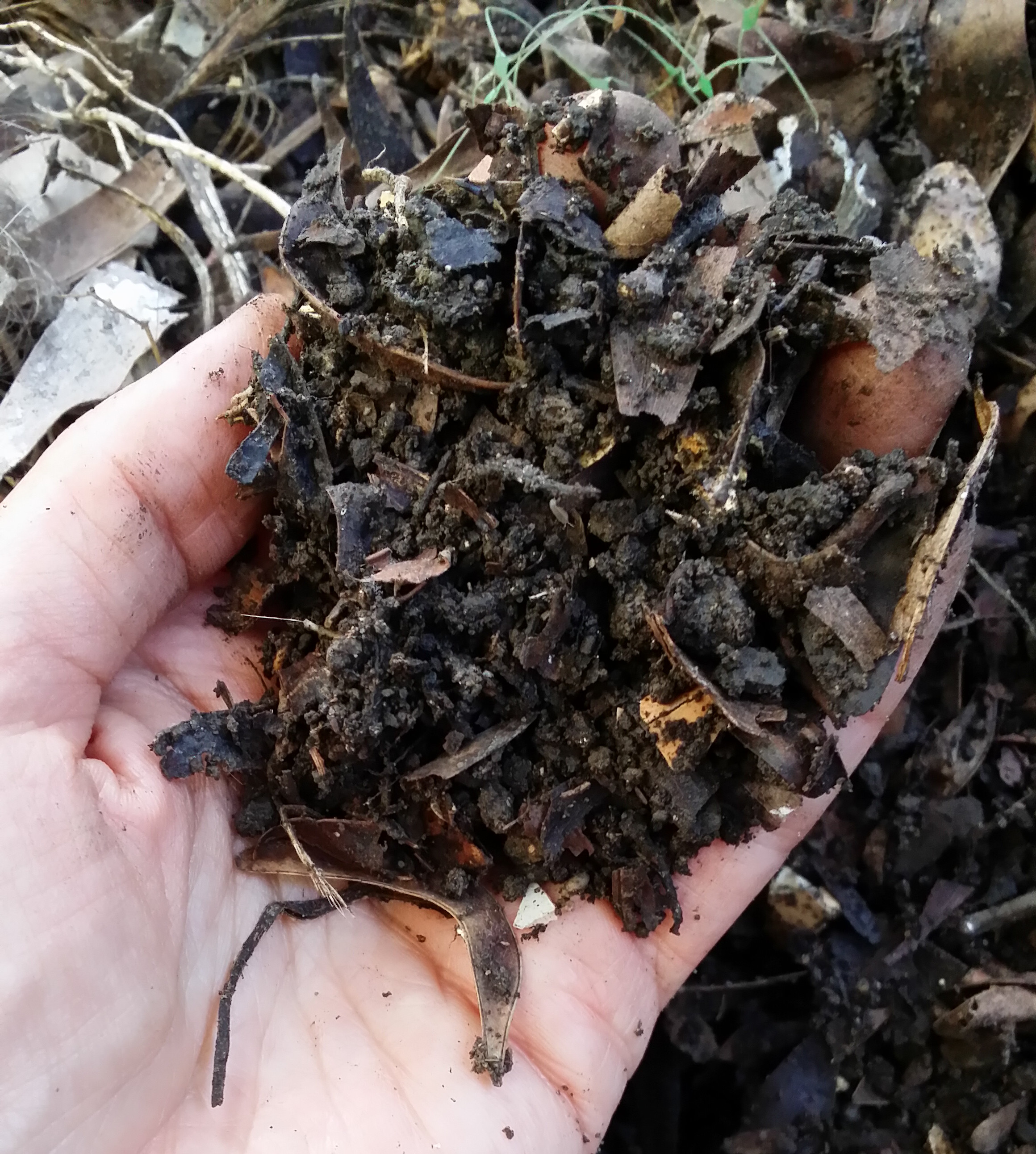
Look at that beautiful, rich black gold! And I love the earthy smell! Done properly, compost does not smell at all. Even with the addition of urine. The fact that I sometimes add urine to my pile will no doubt horrify some, but I think the fact that it can horrify just shows how detached we are from nature.
Urine contains high amounts of nitrogen. Dry brown materials contain more carbon. A low carbon-to-nitrogen ratio (say 7:1 as opposed to 35:1) decomposes organic matter quickly.

On the weekend, my neighbor ripped out the vines in a bed outside of my yard and worked the compost into the soil. I planted a few squash seeds in there I saved recently. Perhaps I planted too late in the year but I enjoy experimenting.

