

I live in Silicon Valley, high-tech central. Almost everyone I know is an engineer, married to an engineer or divorced from an engineer. I see more Teslas here than minivans. When the tech-heavy NASDAQ has a really, really bad day, stores like Fry’s Electronics (geek central where you buy parts to build your own computer) have a really, really bad day. I see people wearing Google Glass in public on a regular basis. Even I, near-luddite, have tried it.

Don’t get me wrong, I love living here and I like technology (mostly). But I get more excited by really old (and really smart) technology. Like grist mills.

The Bale Grist Mill
This past week, my kids and I visited Napa Valley, a foodie’s paradise. On our way home, we stopped for a tour of Bale Grist Mill, now a state historic park. Built in 1846, the water-powered mill once served as an important social hub in the area. Local farmers brought in their grain for milling, caught up with their neighbors and shared news and gossip. They paid the miller a 6 percent, in-kind fee (people didn’t use money much) to grind up grains such as wheat, corn, buckwheat and rye. Today, the mill still grinds grain, but only on Saturdays.
How the Mill Works


Above is a picture of the underside of the flume. In the old days, water ran down this flume from ponds up in the hills behind the mill. The water would then fall over the water wheel, causing it to turn. Today, the park no longer owns the water rights to those ponds, so it pumps water up to the top of a shortened flume, which runs down and falls over the wheel in the same way as it had in pioneer times. A pump then sends that water back to the top of the flume, creating a closed system that recycles the water.

The big wooden wheel outside the mill turns these wooden gears under the floor inside. They were (and are) made of wood because if a wooden gear broke down, it could be repaired easily compared to a broken-down metal gear, and the mill could get up and running again quickly (time was money in 1846 too).
These gears make everything else in the mill turn. A grist mill is an amazing example of simple clean-tech powered by only water assisted by gravity.


Those first gears turn the gears above. Turned by that second set of gears, wheels with long belts are all over the place, powering the equipment and making the whole process work. 
I didn’t catch everything our excellent tour guide told us, but I’m pretty sure that in the pic above, the spinning cylinder with the mesh cover cleans the grain. Centrifugal forces separate the grain from dirt.

The clean grain then falls down a chute to the hopper. You can’t make it out very well above, but the hopper is the inverted wooden pyramid perched above the big round contraption.
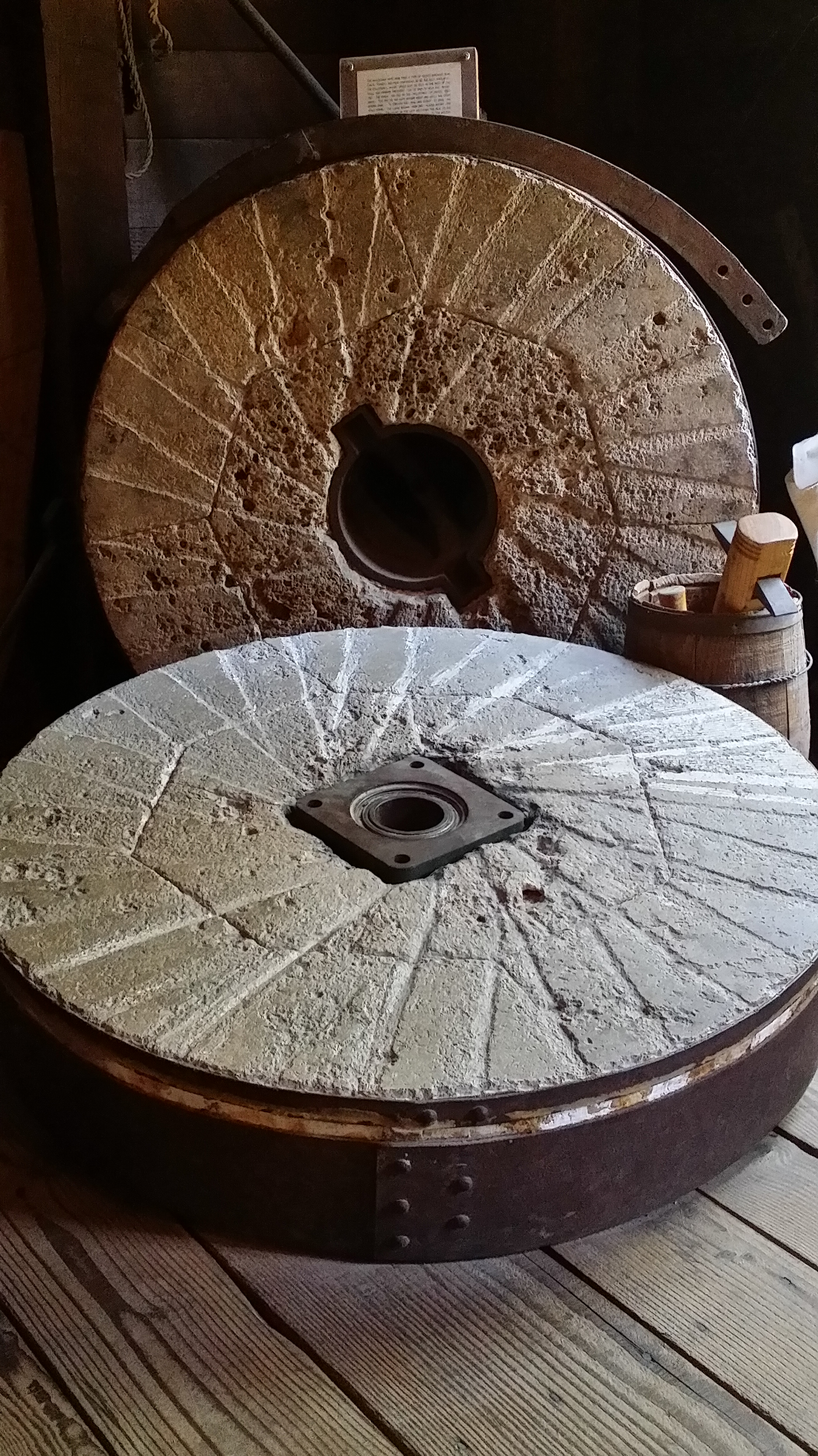
Inside that round wooden compartment sit two grinding stones—one fixed on the bottom and one that rotates above it. The grain falls between the grindstones through the hopper. As the top grindstone turns, it crushes the grain. The width between the stones (the thickness of six sheets of paper versus the thickness of two sheets of paper) determines the coarseness of the flour.

Ground flour then falls out a wooden chute into a large bag. I didn’t quite get a shot of that—my daughter had to go to the bathroom just then—but you can see the flour that missed the bag and spilled on the floor. It smelled wonderful—warm, fresh and bread-like.

From there, the flour is conveyed to the top floor, where it goes to the bolter, the long cylinder in the right of this photo. The bolter separates the flour into different types—pastry flour or bread flour (for the wealthy), middling flour (what most people ate) and bran (for the pigs—they ate the healthiest part). Each type goes down its own chute and into bins below.

The design of this particular mill comes from the very old book The Young Mill-Wright and Miller’s Guide. In the back of the book, you’ll find the above list of satisfied customers (kind of like an 1800s version of Yelp).

At the end of 2013, a bill that would have exempted the mill from state health codes—thus allowing it to sell its freshly ground flour to the public—failed. Modern health codes require food establishments to be made of steel and concrete—not wood like the mill. As a compromise, the mill can exchange a souvenir bag of flour to visitors for a donation of five dollars…

…as long as no one eats it. You can read the whole story here.
I bought four bags, one each of whole wheat bread flour, pastry flour, rye flour and buckwheat flour. (Yes, it’s packaged in paper, but I’ll reuse the paper somehow—no way I was not buying the mill’s flour). This week, I’ll use my flour to bake sourdough bread (likely to be the best ever) and enjoy a slice with a glass of raw milk and feel like a rebel.