

This past Saturday, I participated in Feeding the 5000, a campaign that exposes food waste by feeding thousands of people a free, delicious meal prepared with food that would otherwise go to waste. Feeding the 5000 began in Europe in 2009, but Saturday marked its debut in America.

The event’s name invokes the story of Jesus feeding 5,000 people with a mere five loaves and two fishes. We had quite a bit more to work with than that. After I arrived at St. Vincent de Paul in Oakland on Friday morning to chop vegetables for Saturday’s event, we volunteers started in on the 4,000* pounds of sweet potatoes pictured above.

Why would these delicious, perfectly edible sweet potatoes have headed to landfill had they not gone into soup? They were too large to sell. Grocery stores refuse to take them.
In the US, we waste 40% of the food we produce. Tossing perfectly edible food represents an obscene waste of resources all along the food’s life-cycle and contributes to climate change. Food crops account for 80% of water consumption in the US. Farmers burn fossil fuels to run equipment that helps them produce a large amount of food that no one will ever eat. Once discarded food arrives at the (overburdened) landfill, it releases methane gas as it decomposes.
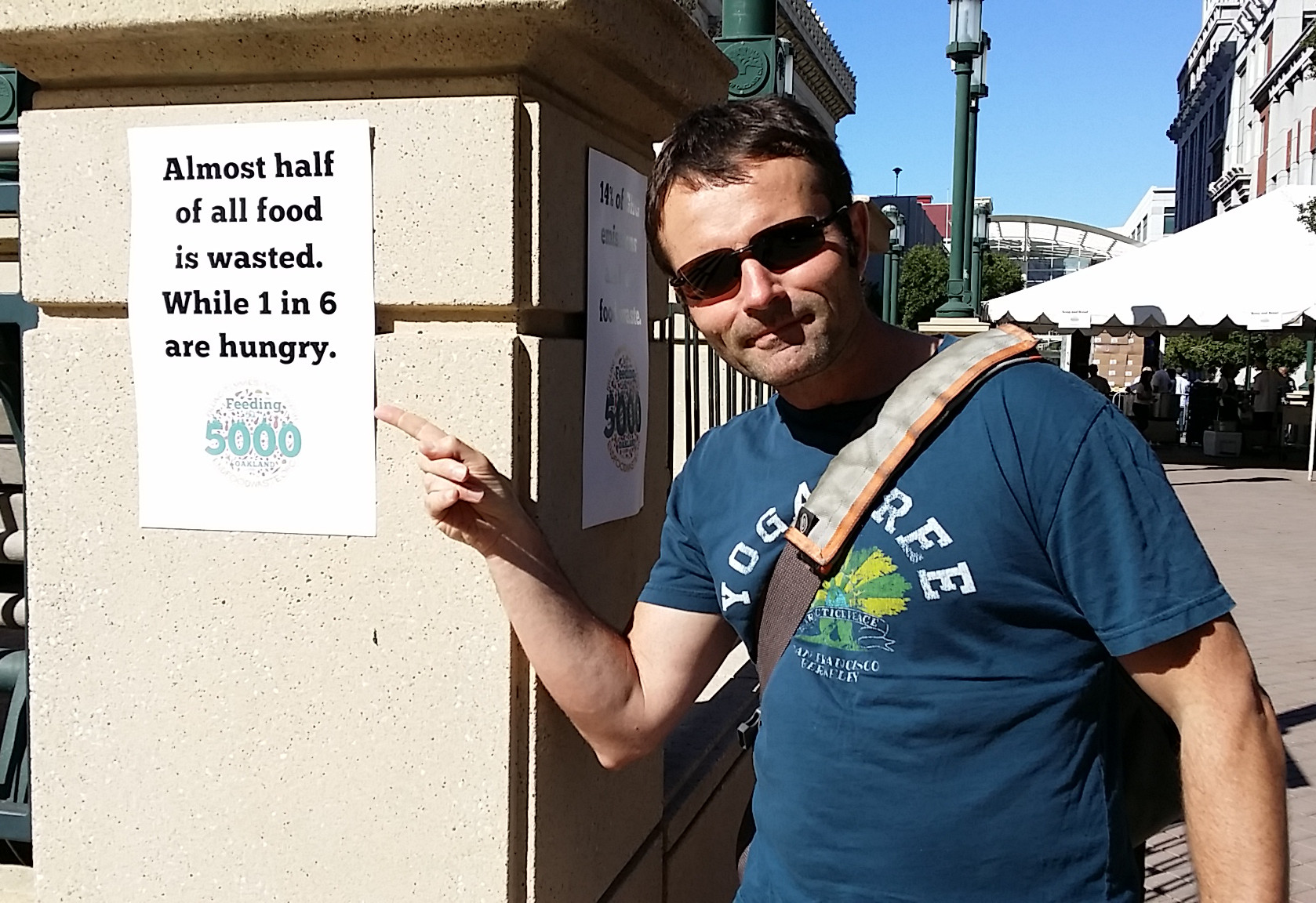
Meanwhile, as Vlad literally points out above, 1 in 6 Americans goes hungry. Our industrial food system is madness.
Yet, as Tristram Stuart, founder of Feeding the 5000, said on Saturday, “The great thing about food waste is that the problem is edible.” And eat people did. When I asked the indefatigable event manager, Jordan Figueiredo of EndFoodWaste.org, for a tally of the day’s food numbers, he said:
We fed thousands on fruit and greens smoothies; rolls and bags of bread; sweet potato, caramelized onion and carrot soup; and grocery giveaways of sweet potatoes, squash, onions, carrots and apples. All from 11,000 pounds of produce, 2,000 rolls and 2,000 bags of bread that would have been wasted were it not for Feeding the 5000 Oakland.


In addition to the free lunch and free produce giveaway, various speakers, chefs and performers took to the stage. I didn’t have a chance to hear all of the impressive speakers in the lineup, but I’ll give you a few short tidbits.

I was so happy to meet in person the remarkable, kind and all around wonderful human being, Rob Greenfield. By cycling across the country barefoot on his bamboo bike and dumpster diving behind grocery stores, this environmental activist has helped expose the shocking extent of our nation’s food waste. At Feeding the 5k, Rob said he finds about $2,500 worth of edible, fresh, tasty food in these dumpsters in a matter of hours. He added that only the size of the borrowed vehicle in which he hauls away the food prevents him from taking more. Rob then spreads the food out at a nearby park, where people help themselves to it. You can check out the pics of his food fiascos here.

Chef Olive and nutrition consultant Lisa Miller, of Berkeley cooking school Kitchen on Fire explained how to make soup. I thought this was a brilliant demonstration. If you want to cut down on food waste at home, learn how to make soup. Their tips included:
- Shred vegetables to cook them faster
- Have a squash? Cook it at 400°F, add it to soup and puree
- Toss apples into soup
- Cook vegetables, blend what you need into soup and refrigerate the rest
- Use up wilting, yet perfectly good vegetables in soup
- Add slow-cooking vegetables at the beginning, quicker-cooking at the end

During a break between sets, these dancing bananas entertained the crowd while holding up signs urging us to text “Shift 41444” to donate money to the non-profit Food Shift. The mission of the organization?
Food Shift works collaboratively with communities, businesses and governments to develop long-term sustainable solutions to reduce food waste and build more resilient communities.
Check out Food Shift’s website here and learn how to cut down on waste and how you can get involved.
Finally…

Here I am on stage with Jordan, giving a demonstration on fermenting sauerkraut, loosely following my fermentation workshop outline. If you read my blog at all or follow me on social media, you may know that I am obsessed with fermentation. I almost need an intervention. When Jordan approached me about doing a demo for Feeding the 5k, fermentation was the first thing I thought of. If you want to prevent waste, learn how to preserve food, something fermentation does efficiently and deliciously.
And to help cut down on food waste at home, check out my upcycled food waste posts:
- Vegetable broth from scraps
- Bread crumb labor
- Bone broth
- Fermented watermelon rind pickles
- Fried potato peels
- DIY lard
One last note. Someone tweeted me after the event, asking for my number one tip for cutting down on food waste at home. It didn’t have to ponder that question for long:
Learn to cook.
So I do realize that some people work two jobs and go to school and raise kids and have no time, but as Michael Pollan points out, “many Americans are spending considerably more time watching images of cooking on television than they are cooking themselves.” Pollan goes on to say that we spend, on average, only 27 minutes per day cooking. Is it any coincidence that as we have spent less and less time cooking, our food waste has increased dramatically (by 50% since the 1970s)? I doubt it. Learn to cook and you learn how to use what you already have. You don’t have to worry about those often-artificial best-before dates, because you’ll make most of your food from scratch. Your food will taste better. You’ll appreciate it more. You’ll waste less.
*We actually chopped only about 1,000 pounds for the soup and gave the rest away at the event.