


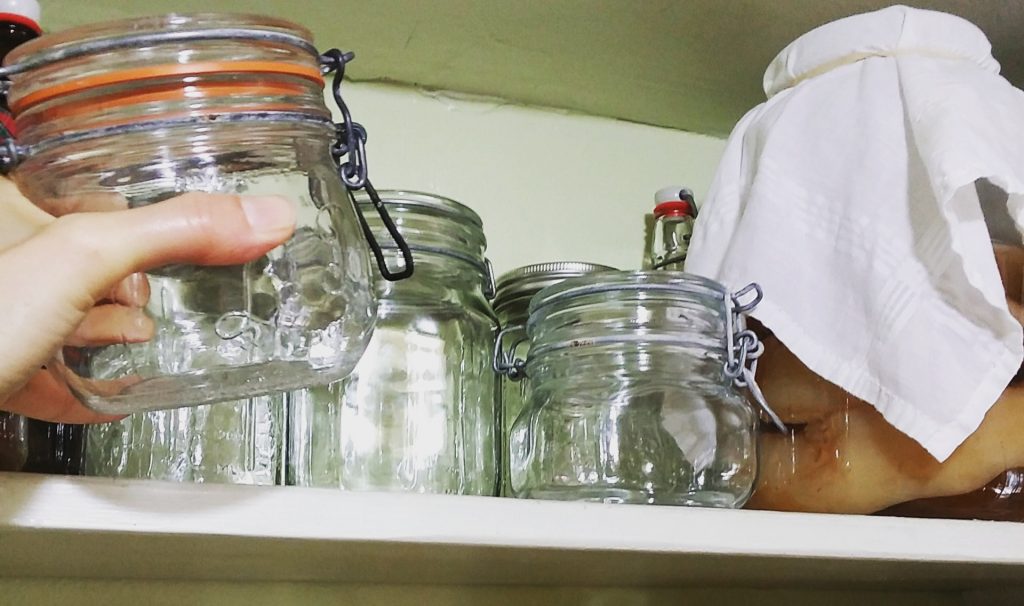
If you’re contemplating going plastic-free or zero-waste in the kitchen, start hoarding jars of all sizes now. Keep them out of the recycling, search the backs of cupboards and your attic and hound your friends and coworkers for theirs. Before you know it, you will have amassed a pile of them.
I rely on the large ones the most (as you can see in the jar collage below) for storing food and for filling up with bulk food. Some stores will “tare” jars. After you fill them up at the bulk bins, the cashier will deduct the weight of the tared jar when you check out. Smaller jars are good for buying and storing spices, tea and other expensive bulk items. Filled with beans, rice, grains, seeds and nuts, your glass jars look great on a kitchen shelf. I keep a stash of jars inside my cloth shopping bags, so I won’t find myself at the store empty-handed.

From the left to right column, top to bottom, here’s what’s inside these babies:
1. Garbanzo beans a.k.a. chick peas. If you go zero-waste, you’ll probably start to eat more beans and legumes. They provide a good source of protein, cost little and unlike meat, are easy to buy waste-free. I bought these in bulk in a cloth bag and transferred them to the jar at home.
2. Frozen cherries. My daughter picked these for us at her dad’s last week. We had so many, I pitted and froze some for later.
3. Bread flour. I make bread from wild starter (see #8) and add about 25 percent bread flour. I bought this in bulk in the jar.
4. Preserved lemons. I preserved these using this recipe (so, so easy). The lemons came from the kids’ dad’s backyard.
5. Popcorn kernels. I bought this in bulk at Rainbow. I make popcorn following this ridiculously simple recipe.
6. Beet kvass. I started this fermentation yesterday. You can buy fancy glass containers for fermenting food, but I just reuse mason jars or pickle jars for these science experiments.
7. Buttermilk. This is also very easy to make (do you notice a theme?). Here’s the recipe.
8. Sourdough starter. My pride and joy. I use this rather than commercial yeast to bake bread, and I (mostly) follow Michael Pollan’s bread recipe from his book Cooked. I had a different starter last year, but I let her die and started this new one. She wasn’t very perky. It may be because I had named her Heloise, of Abelard and Heloise, clandestine and doomed 12th century lovers. Considering how things turned out for them (Heloise’s uncle sent thugs to Abelard’s house to castrate him in his bed in the middle of the night; Heloise subsequently agreed to join a convent), the name may not have been the best choice. I haven’t named this new starter yet. I’m thinking Suzy or Kathy—something bubbly and cheery and ending in “y.” If you have a good name, please let me know. The short time-lapse video below shows my starter rise and fall after a feeding.
Update: I went with the name Eleanor, after Eleanor of Aquitaine. Here’s how to make a starter of your own.

9. Buckwheat. This came from the bulk bins. I have a flour mill and I sometimes grind a little of this up for sourdough waffles or pancakes. When Charlotte and her friends were younger, they would ask “Can we please grind the flour in the flour mill [which takes forever and makes your arm feel like it will fall off].” I would always say, Tom Sawyer-like, “Well, I guess you can do it just this once.” Buckwheat has a lot of protein.
10. Yogurt. I made this myself. This is the recipe.
11. Vegetable broth. I save scraps of vegetables in jars and freeze them. When I have a big enough pile—and need broth—I make it like this.
12. Steel-cut oats. I also bought these at Rainbow. You can quickly prepare them the night before and wake up to delicious Irish oatmeal in the morning. Here’s the recipe. Someone gave me that glass moonshine jug in the pic for water. I live in an intentional community and we have a water filter in our community kitchen so I fill my glass water jugs up over there.
13. Pasta. I wish Charlotte loved pasta a bit less but I was happy to find all kinds in the bulk section at Rainbow.
14. Peanut butter. I bring my jar to Whole Foods and fill it up at the peanut grinding machine. You can also make it yourself in a food processor—just grind up peanuts.
15. Tomato sauce. I made this from fresh tomatoes and it’s easy. Here’s the recipe.
16. Sauerkraut. Probably one of most common ferments. Here’s my kraut recipe. I try to eat my microbes every day. I would like to participate in the American Gut project and find out what’s in my gut, but I’m also a little afraid to know.
Happy jar scavenging!