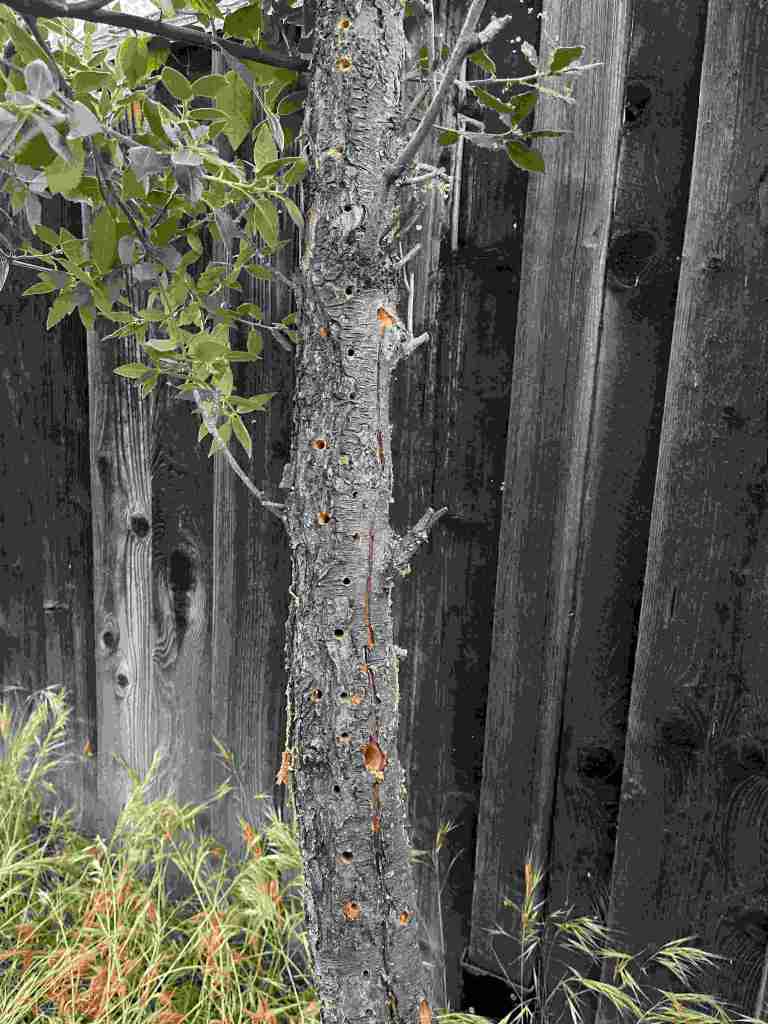
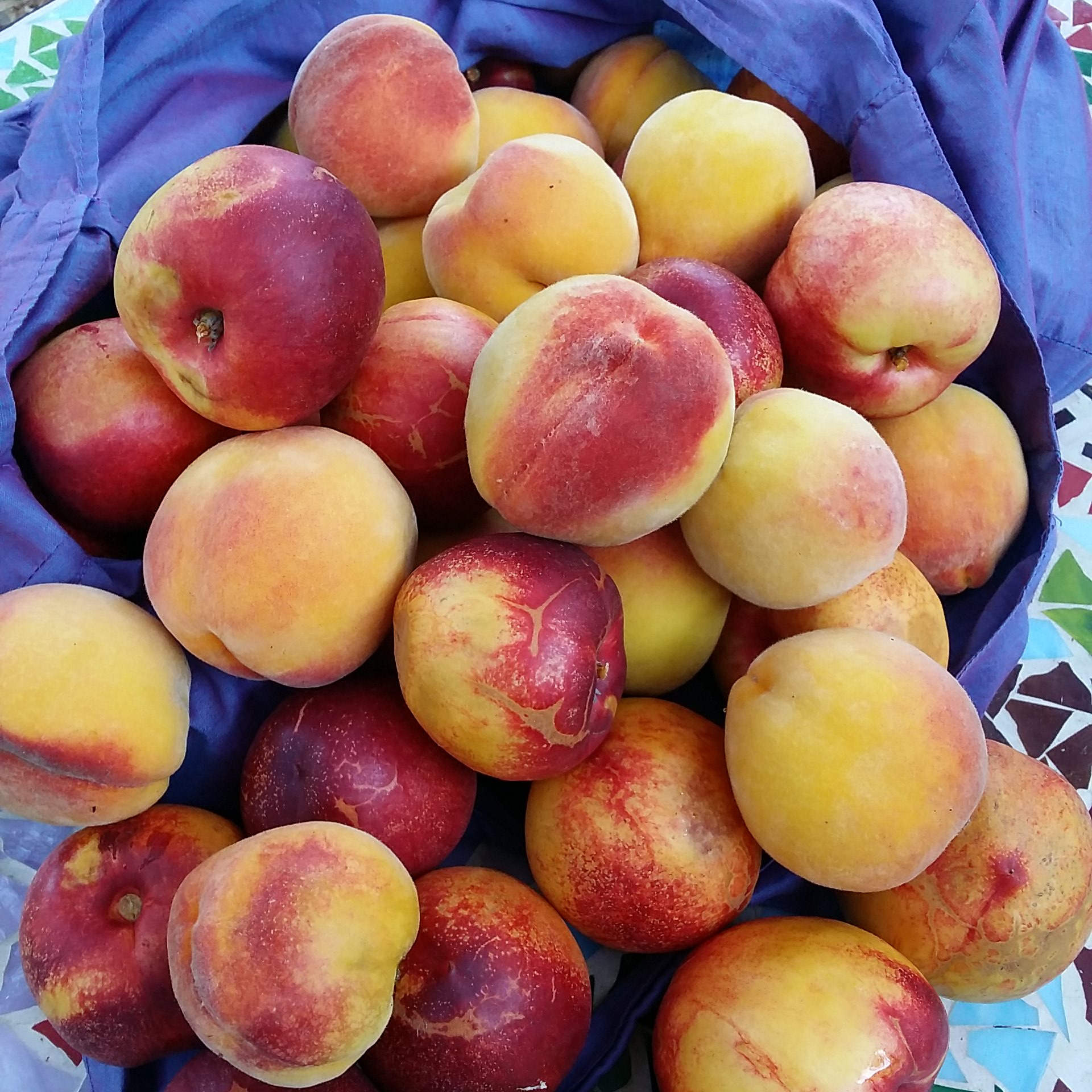
Our standing dead nectarine tree—a snag—can still help bear fruit. How? It now serves as a nesting site for bees. The bees raised in our snag can go on to pollinate fruit, vegetables, flowers and other plants. As entomologist Doug Tallamy writes in Nature’s Best Hope,
Pollinators are essential to life as we know it on planet Earth. In addition to pollinating a third of our crops, animals (bees, bats, hummingbirds, and others, but mostly bees) are responsible for pollinating 87 percent of all plants and 90 percent of angiosperms (flowering plants). […] So if pollinators were to disappear, 87 to 90 percent of the plants on planet Earth would also disappear. Not only would such a loss be a fatal blow to humans, it would take most other multicellular species with it as well.
But stresses such as habitat loss, pesticides and climate change have decimated bee populations. According to the Center for Biological Diversity, “Among native [North American and Hawaiian] bee species with sufficient data to assess (1,437), more than half (749) are declining” and nearly “1 in 4 (347 native bee species) is imperiled and at increasing risk of extinction.” Snags can help these essential, beleaguered, amazing creatures.
So, yes, our dead tree still plays a role in bearing fruit—just not fruit on the tree itself.


What is a snag?
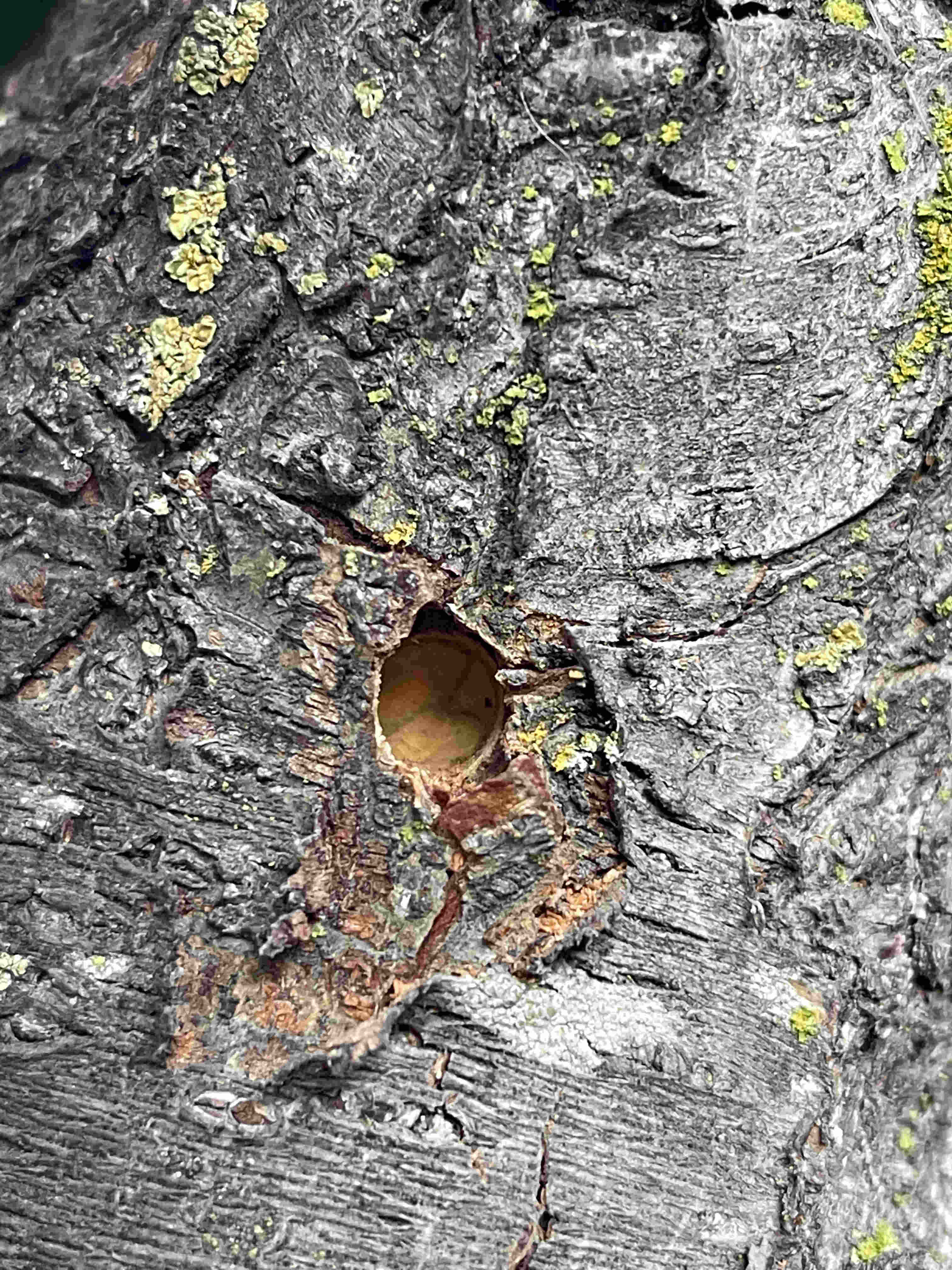
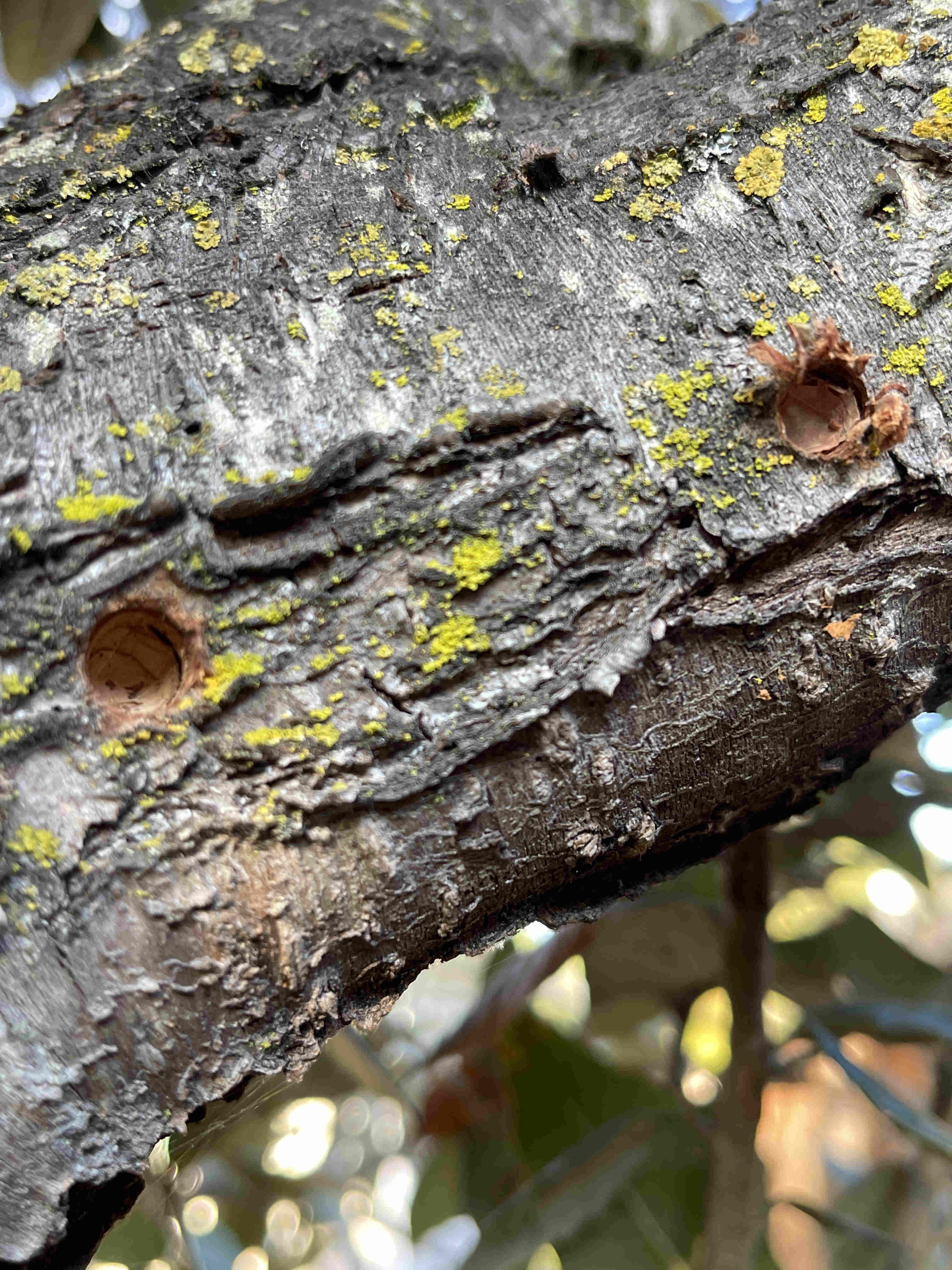
A snag is a still-standing dead tree. In a forest, various wood-boring insects create cavities in dead trees, openings that bees can nest in. In our yard, we’ve sped things up with a drill to mimic the work of these industrious insects.
About 30 percent of native bee species in North America build their nests aboveground, in snags like this, pithy plant stems, brush piles and other openings, such as the cavities of commercial bee blocks.
What our first snag residents are up to
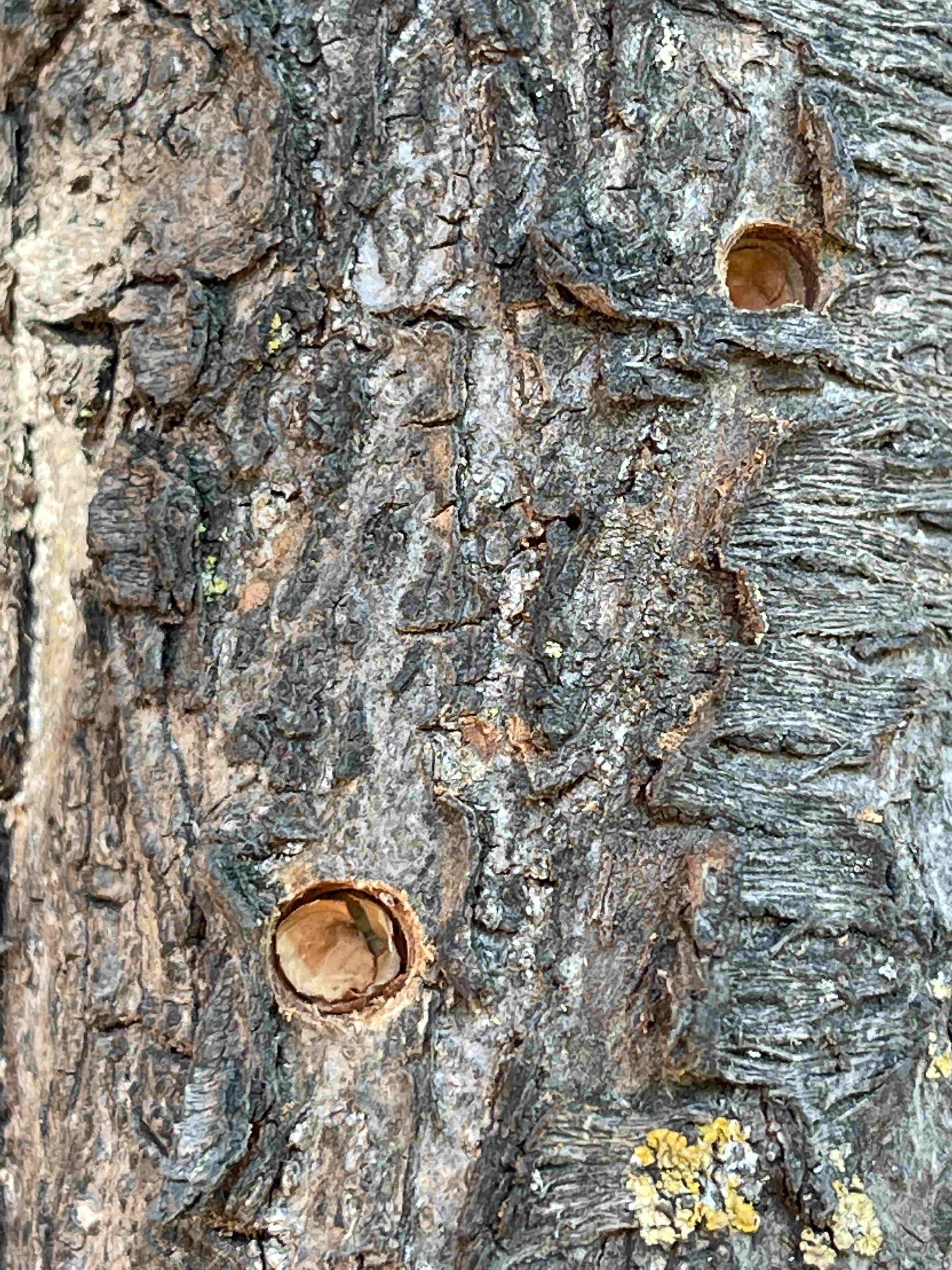
Bits of leaves plugging up several of the snag’s cavities provide a clue that leafcutter bees (Megachile species) have discovered our snag. Like other solitary bees, leafcutter bees do not live in hives with one queen bee domineering many workers that do her bidding. Rather, each solitary female builds her own nest, although several bees may build in the same snag neighborhood.
Starting at the back of the cavity, the bee creates a cell by depositing pollen and laying an egg on it. She seals up the cell, creates subsequent cells and caps the cavity’s opening with either mud, resin or pieces of leaves. After the larvae hatch, they eat their pollen, pupate in their cells and eventually emerge as adults. (I hope I am able to snag some pictures of them.)

How to turn a snag into a bee nursery
Insects will do it themselves eventually but we’ve sped the process up. Before starting, we hired someone to trim the dead branches reaching up into the power lines and put many of those in our raised hugelkultur beds. Nothing goes to waste around here, not even dead wood! If you have a very large dead tree in danger of toppling over, you’d want to trim the dead canopy.
Height of cavities
Our bees built their nests in the cavities we drilled higher up on the tree—between four feet to the top of the snag, six feet.
Cavity dimensions
Drill different sizes for different bees. We drilled holes 1/4-inch, 3/8-inch and 1/2-inch in diameter. The cavities are about 4 inches deep (as far as we could get with our drill bit). If you can, drill deeper, about 6 inches. So far, our occupants prefer the 1/4-inch holes.
Where to drill
The holes face east and southeast—out of direct afternoon sun, which would be too hot. You don’t want to accidentally cook the bees.
Protection from rain
As you drill, aim the bit at a slight upward angle. This will prevent rain from pouring into the tunnel and drowning the bee larvae.
In addition to this slight upward angle, a small covering like a piece of wood nailed to the tree will also help protect the nests from the rain (hopefully we have some rain this winter in California). The canopy of the oak tree near our snag does offer some protection. But I’ll have to attach a little roof to the snag as well.
How to provide food for bees
The emerging bees will need nectar to eat and female bees will also need pollen to provision their offspring. Native bees evolved alongside native plants under local soil and climate conditions. So you’ll want to plant native. Natives require less water and tend to thrive without fertilizers and pesticides, unlike many non-native, introduced plants.
Xerces, an invertebrate conservation non-profit organization, is a good place to start to look for plants in the US and parts of Canada. Check out Xerces’ pollinator-friendly plant lists here. These regional lists categorize plants by season, making it easier to choose a variety of plants that will provide bees with food throughout the year. You’ll also find lots of helpful info at the Pollinator Conservation Resource Center here.
Next, to find out more about the plants on the pollinator list, check your state’s or province’s native plant society. I am obsessed with our native plant society’s plant finder site, Calscape. After I looked at the Xerces list of plants for pollinators in California, I then searched for these plants on Calscape. Like National Wildlife Federation’s plant finder, I can look up plants native to my zip code.
Some plants on my wish list
On Calscape, I store a few plant lists, including “Bee Dinner.”
- Lacy phacelia (Phacelia tanacetifolia). Calscape says this pretty plant will do well in my area. I’ll have to replant this annual every year though. It’s the least I can do for the bees! Lacy phacelia is a type of borage. I’ve seen how bees react to the purple-blue flowers of borage—they go wild! This plant flowers in spring.
- California Poppy (Eschscholzia californica). In spring and summer, we have loads of California poppies in our yard. Pollinators love them. I’m not sure if the pollinators gestating in our snag love them or not but bumblebees certainly do. These self-seed every year without any help from us.
- Rock phacelia (Phacelia californica). This fast-growing perennial plant flowers in spring and summer. Once established, it requires zero irrigation in summer—perfect for our climate.
- California Goldenrod (Solidago velutina ssp. californica). I’ve planted goldenrod in the front yard (the snag is in the back) and will try propagating more in the spring. Goldenrod is a keystone plant. Keystone plants provide support for the entire ecosystem. Like a Roman arch, without keystones, the ecosystem falls apart. Goldenrod blooms in the summer and fall.
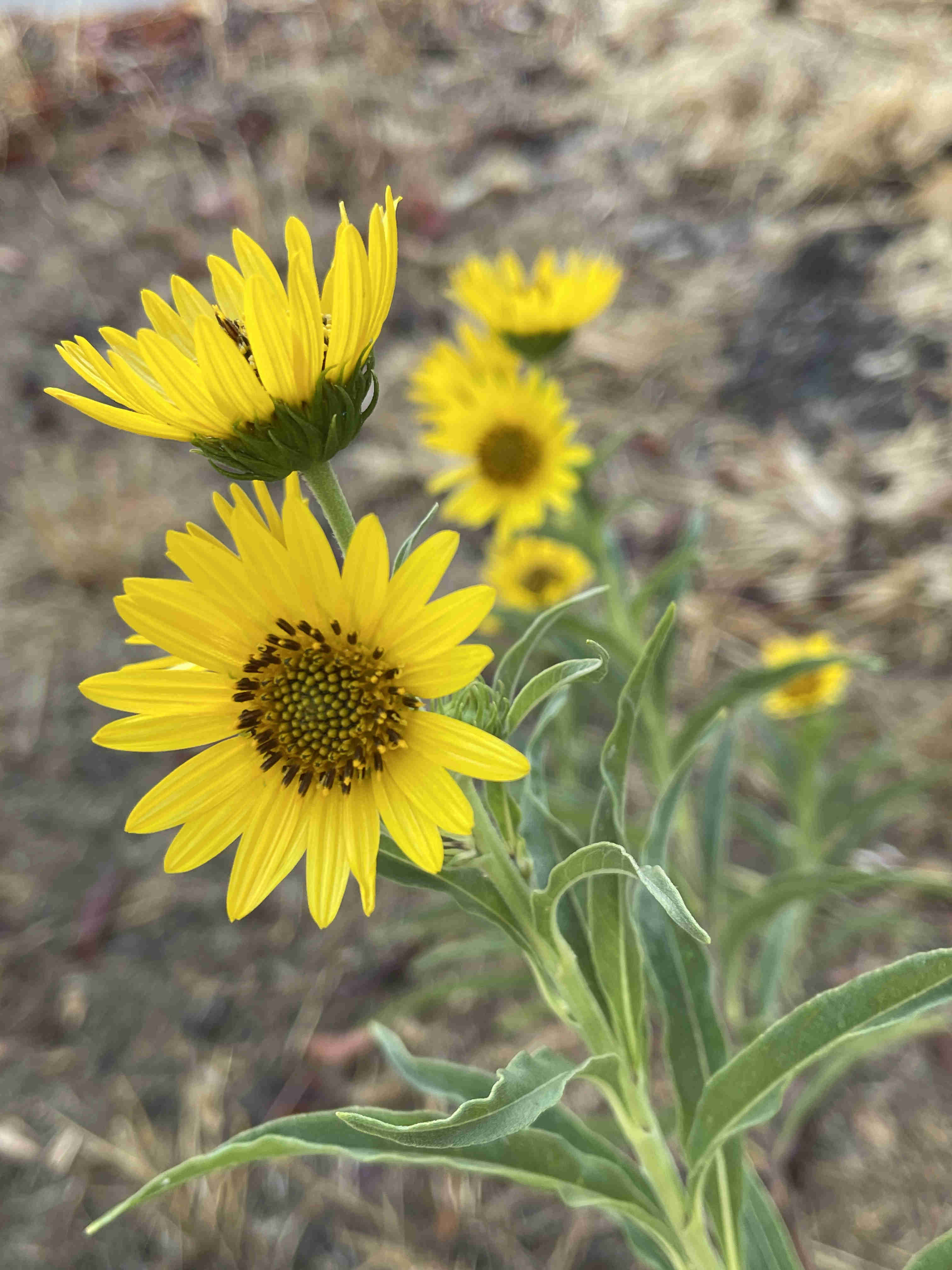
- California sunflower (Helianthus californicus). I’ve also planted this keystone plant in the front and have seen many small bees on the flowers. I’ll have to plant some near the snag. It blooms in summer and fall.
- California Aster (Corethrogyne filaginifolia). Bumblebees like this keystone plant. It blooms late in the year.
While I’m out there, I’ll plant some milkweed for monarchs. I could go on and on about my wishlist but I’ll stop now.

Where to plant
Most flowering plants that provide bees with nectar require direct sun. We tore out some of the concrete in the sunny backyard to plant more natives there. Ideally, we would tear out all of the concrete but that’s a big can of invasive worms I can’t deal with at the moment. (Don’t let perfect be the enemy of the good…)
Now that I’ve picked out some plants, I’ll order them from the native nursery. From the landscape supply company, I’ll order two cubic yards of topsoil to fill in our newly liberated spots. Look for new and improved photos…eventually! (This project is ongoing.)

Bees also need water
In addition to food, bees need water. A shallow bowl or pie plate filled with water and small rocks provides a simple source. The bees will perch on the rocks to drink without drowning. If your yard is like mine, you’ll now have a use for some of the small rocks you constantly find in the soil while planting. Change the water often to deter mosquitoes.
Other ways to help bees
- Provide open patches of loose soil. Bees that nest underground will be able to excavate the soil. They can’t burrow in compacted soil, such as the soil beneath lawns.
- Let pithy stems of dead flowers stand. Bees will nest in the cavities of stems such as goldenrods, blackberries and hydrangeas. I know your neighbors may frown upon your slightly messy yard. But marketing the artificially perfect, manicured lawn played a role getting us into an actual mess—the biodiversity crisis.
- Leave the leaves. I watched Doug Tallamy discuss this on Instagram yesterday. Reminding viewers that “Leaves aren’t garbage,” Tallamy said that our trees should have beds of leaves under their canopies to enable the leaves to return their nutrients to the tree. He also suggested starting a new bed under a tree simply by raking the leaves into a thick pile beneath it. The leaves will smother any grass and you can plant directly there the following year. Easy and brilliant!
- Avoid chemical fertilizers and pesticides. These can be toxic to bees.
In other words, don’t tidy up your yard so much as to make it inhospitable to bees. They won’t find anywhere to nest.
- You can also build bee blocks. Several small bee blocks scattered throughout the yard work better than one large centralized bee hotel. If a predator stumbles upon a large bee hotel, it can eat all the larvae in one gluttonous swoop. Go here for instructions on building and managing bee hotels. If you buy a bee hotel, you need to clean it after the bees vacate in order to prevent parasites from moving in. From what I’ve read, snags resist diseases better than bee hotels.
- Sign petitions. This petition from the NRDC urges the EPA to ban neonicotinoids, pesticides that decimate bee populations. Please sign here.
More resources
- For more on the importance of planting natives—to insects and to us—go here.
- While you wait for the bees to pupate and your plants to grow, read Doug Tallamy’s wonderful book, Nature’s Best Hope. (It changed my life.)
- Find all kinds of resources on planting natives at Homegrown Nation Park, Tallamy’s grassroots effort to regenerate biodiversity.
Accolades for my cookbook, The Zero-Waste Chef: Plant-Forward Recipes and Tips for a Sustainable Kitchen and Planet!
- Shortlisted for a Taste Canada Award
- Finalist for the International Association of Culinary Professionals Cookbook Awards
- Shortlisted for a Gourmand World Cookbook Award
You can check out the book here.